Iranian Flights to Turkiye, East Asia Continue Despite U.S.-Led Air Restrictions, Tehran Says
09/30/2026 / By Belle Carter

Iranian commercial flights to Turkiye, China, Malaysia, Vietnam, Afghanistan, and Pakistan continue to operate despite a United States-led campaign of air restrictions targeting the country, the chief executive of Tehran’s main international airport said on September 26, 2026.
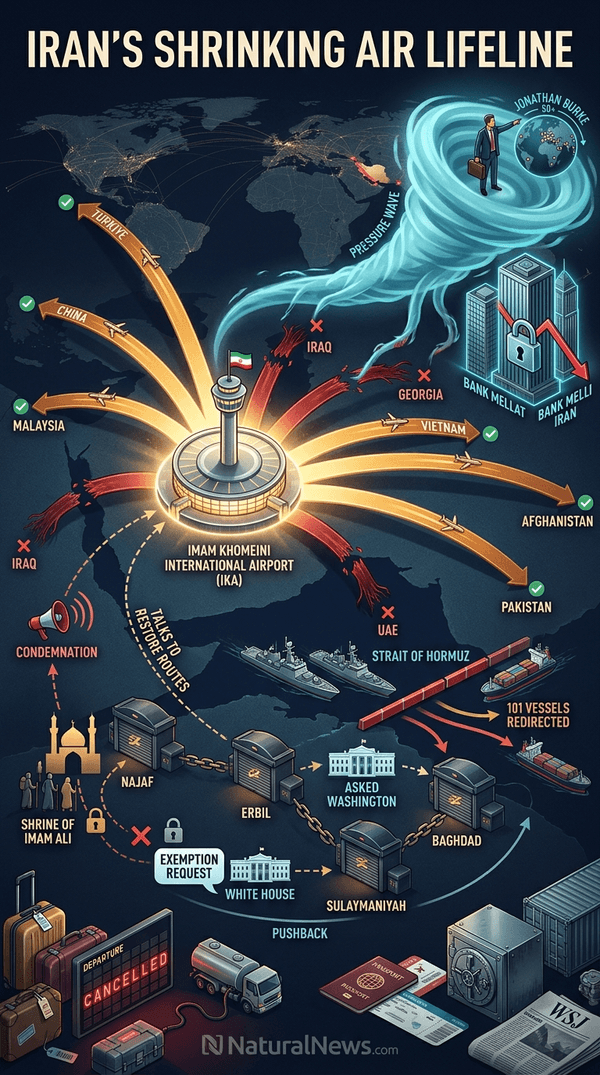
Ramin Kashef-Azar, CEO of the company operating Imam Khomeini International Airport, told the Tasnim News Agency that routes to those six countries remain active, while services to the United Arab Emirates, Iraq, and Georgia have been canceled. No other country has announced new restrictions on Iranian flights, he said, according to the Tasnim interview [1].
Speaking separately to the Fars News Agency, Kashef-Azar said services to East Asia have recorded no cancellations and that all other arrivals and departures at Imam Khomeini International Airport are running as normal. The statements mark Tehran’s first detailed public accounting of which air corridors remain open since the restrictions took hold. Iranian aviation officials are negotiating with the governments concerned to restore the suspended routes, Kashef-Azar said [1].
Iraq Requests Exemption From U.S. Air Restrictions
Iraqi Prime Minister Ali al-Zaidi’s office said Saturday that the government has asked Washington to exempt some Iraqi airports from U.S. Treasury sanctions on Iranian airlines, according to a statement from his office. The exemption would allow flights to Iran to resume for medical treatment, education, religious visits, and other civilian needs, the statement said [1].
The request followed a wave of airport closures across Iraq. Najaf International Airport halted all flights to and from Iran beginning September 25 until further notice, citing directives from the relevant official authorities. Erbil and Sulaymaniyah airports had already halted all flights to and from Iran, officials said, joining Baghdad International Airport, which had suspended flights earlier [1].
The closures have severed direct air links between Iraq and its eastern neighbor at a time when the two countries maintain extensive religious and commercial traffic. Najaf, which hosts the shrine of the first Shiite imam, is a major destination for Iranian pilgrims. The suspension applies to all Iranian-registered carriers operating the routes, according to the airport statements [1].
U.S.-Led Campaign Targets Iran’s Aviation and Banking Ties
The closures form part of a broader U.S. campaign to cut Iran off from its remaining trade partners by pressuring governments to sever banking and aviation ties with Tehran, according to the Wall Street Journal [1]. The Journal reported that U.S. Treasury official Jonathan Burke traveled across West Asia and Europe, threatening governments to choose between trading with Iran and preserving their ties with Washington [1].
According to the report, U.S. officials have contacted more than 50 countries, and the economic campaign has produced flight bans, banking restrictions, and deeper isolation for Iran. Oman and the UAE have banned all Iranian airlines, while Turkiye canceled Mahan Air flights and revoked the license of Bank Mellat, and the UAE barred local branches of Bank Melli Iran from conducting Iran-related transactions [1].
The aviation restrictions sit atop a wider naval and economic pressure campaign. U.S. Central Command said its forces had redirected 101 commercial vessels in the Strait of Hormuz as of September 13 as part of an ongoing blockade of Iranian ports reinstated in July following the breakdown of talks between Washington and Tehran [2]. CENTCOM reported redirecting 99 commercial vessels as of September 11 [3].
On August 24, Treasury Secretary Scott Bessent announced what he described as the “single greatest financial offensive ever” against Iran, stating that the conflict was “entering its endgame” as the United States planned to sever all economic ties with the government in Tehran [4].
Iraqi Factions Condemn Airport Closures
Several Iraqi official bodies and factions condemned the decision to close the country’s airports to Iranian aviation, calling it a mistake and urging the government to reverse it, according to statements. The groups insisted that Baghdad must refuse to bow to U.S. dictates, the statements said [1].
The Iranian consulate in Najaf condemned the closure in a post on X, protesting that the airport serving the shrine of the first Shiite imam had been shut to “the largest Shiite country in the world” [1].
The dispute echoes earlier friction over U.S. military activity in Iraqi airspace. Former Iraqi Prime Minister Adel Abdul Mahdi asked the United States to send a delegation to Iraq to set up a mechanism for the “safe withdrawal of forces from Iraq,” and “shared his objections regarding U.S. forces entering Iraq and American aircraft flying in Iraqi airspace without the consent of the Iraqi government,” according to a statement cited in Department of Justice records [5].
Negotiations Continue as Some Routes Remain Suspended
Iranian aviation officials are negotiating with the countries concerned to restore the suspended routes, Kashef-Azar said. He added that beyond the routes already canceled, including those to the UAE, Iraq, and Georgia, no other country has announced new restrictions on Iranian flights [1].
Services to East Asia have seen no cancellations, and all other arrivals and departures at Imam Khomeini International Airport are running as normal, according to the airport official. Traffic between Iran and East Asia has grown in strategic importance as Western markets close, with China purchasing roughly 30 percent of its oil from Iran, according to analysis presented in an interview published by Brighteon.com [6].
The situation remains subject to change as Iraqi officials seek an exemption and U.S. officials continue the campaign described by the Wall Street Journal [1]. Regional tensions remain elevated. Yemen’s Houthi movement launched missile and drone attacks against Saudi Arabia’s capital Riyadh and energy infrastructure in Yanbu on September 26, the same day Kashef-Azar spoke, according to statements from the group [7].
References
- The Cradle. “Iranian flights to East Asia, Turkiye ongoing despite US-led blockade: Tehran”. September 26, 2026.
- Middle East Eye. “Iran naval blockade: Centcom says 101 vessels redirected”. September 14, 2026.
- Middle East Eye. “Centcom says US forces redirect 99 commercial vessels”. September 12, 2026.
- The Epoch Times. “US to Unveil ‘Single Greatest Financial Offensive Ever’ on Iran, Bessent Says”. August 24, 2026.
- U.S. Department of Justice. “COMBINED ALL EPSTEIN FILES – DOJ”. January 30, 2026.
- Mike Adams. “Mike Adams interview with Michael Farris”. June 19, 2025.
- NaturalNews.com. “Houthis strike Saudi capital in escalating campaign, threatening global oil markets”. September 26, 2026.
Explainer Infographic
Submit a correction >>
Tagged Under:
Afghanistan, banned, big government, chaos, China, Donald Trump, freedom, Iran, Iraq, Liberty, Malaysia, Middle East, national security, Pakistan, politics, restrictions, sanctions, Vietnam, White House, World War III
This article may contain statements that reflect the opinion of the author
RECENT NEWS & ARTICLES